MAINE COON BREED GUIDE
Polydactyl Maine Coons: The Complete Guide to Their Famous Mitten Paws
Few features are as recognizable, or as misunderstood, as the oversized paws of a polydactyl Maine Coon. Whether they appear as thumb-like “mitten paws” or broad, snowshoe-like feet, these extra toes have fascinated cat lovers for centuries.
More than simply a charming characteristic, polydactylism tells the story of adaptation, maritime history, and one of the original traits that helped shape America’s native longhaired cat. In this guide, we’ll explore the science behind the trait, its fascinating history, how to care for those remarkable paws, and why they continue to capture the hearts of Maine Coon enthusiasts around the world.
Explore the guide
IN THIS GUIDE
Everything You Need to Know
What Is Polydactylism?
Why Extra Toes Helped Maine Coons Survive
Ship Cats & Maritime History
Genetics Explained
Health & Paw Care
Frequently Asked Questions
UNDERSTANDING THE TRAIT
What Is a Polydactyl Maine Coon?
Throughout history, the polydactyl trait has often been misunderstood. At various points, extra toes were mistaken for a deformity or viewed as an unusual genetic abnormality simply because they differed from what most people expected to see. Today, veterinary research tells a very different story.
Polydactylism is a naturally occurring genetic trait that causes a cat to be born with extra toes. In Maine Coons, it has been documented for centuries and is considered one of the breed’s oldest and most recognizable characteristics. Far from being a defect, these distinctive paws became part of the breed’s early history and, according to historical accounts, may even have provided practical advantages for working cats navigating snowy terrain and life aboard sailing ships.
Whether those extra digits form thumb-like “mitten paws,” broad “patty paws,” or another unique paw configuration, every polydactyl Maine Coon carries a small piece of the breed’s remarkable history.
POLYDACTYL (NOUN)
Derived from the Greek words poly (many) and dactylos (digits), polydactyl describes a naturally occurring genetic trait that causes a cat to be born with extra toes on one or more paws.
A typical cat has 18 toes, with five toes on each front paw and four on each rear paw. Polydactyl cats are born with one or more additional digits, most commonly on the front paws, although extra toes can also occur on the rear paws.
The number, placement, and shape of these extra digits can vary considerably. Some cats develop a well-defined thumb-like toe that creates the appearance of wearing a mitten, while others develop broader paws with additional digits arranged in a wider row, often referred to as “patty paws.” No two polydactyl paws are exactly alike, making each cat’s paw structure as unique as a fingerprint.
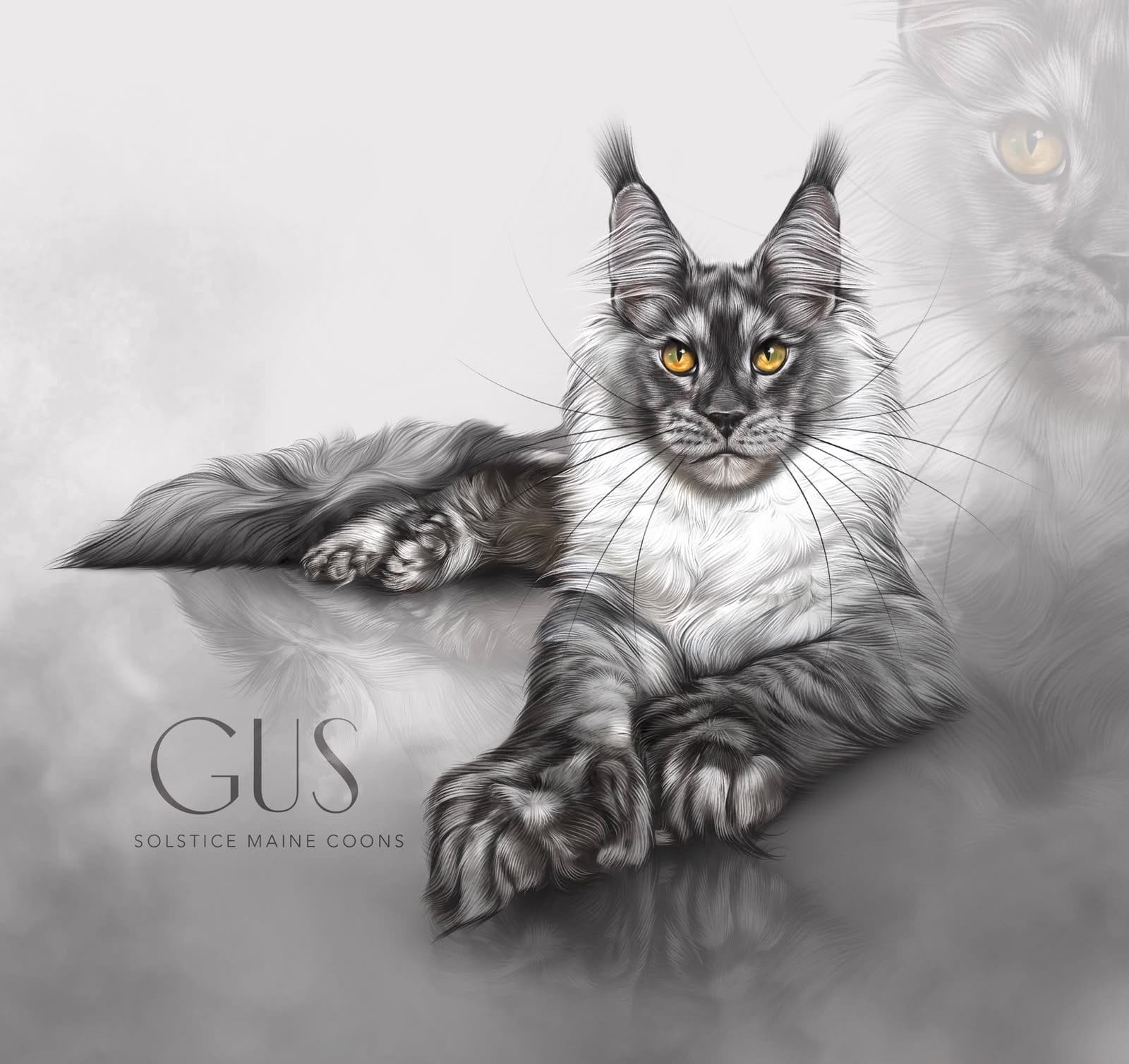
Gus demonstrates one of the many ways polydactyl paws can appear in Maine Coons. Watch how his extra toes naturally spread as he reaches for the feather toy, providing additional grip and flexibility during play.
Veterinary Insight:
Polydactyly in Maine Coons is generally considered a benign inherited trait. Research examining the paws and limbs of polydactyl Maine Coons found considerable variation in digit and skeletal conformation, but no apparent detrimental consequence to feline welfare.
QUICK REFERENCE
Polydactyl Maine Coons at a Glance
Before exploring the history and genetics behind these extraordinary paws, here’s a quick overview of the trait at a glance.
Scientific Name
Polydactylism—derived from the Greek origin meaning "many digits."
The Meaning
A naturally occurring, benign genetic trait that results in the physical expression of extra toes.
Typical Toe Count
Most cats have 18 digits. Polydactyl Maine Coons are born with one or more additional digits, and the total number and distribution can vary considerably from cat to cat.
Most Common Location
The physical trait most frequently presents on the front paws, though the hind paws can also be affected.
Inheritance
An autosomal dominant genetic trait with variable expression, passing down naturally through generations.
Health Impact
Generally considered benign. The presence of extra digits does not inherently affect their health, structural mobility, or lifespan.
Historical Significance
Historical accounts associate polydactyl Maine Coons with New England's working-cat and maritime history, although many claims about the functional advantages of their extra toes remain historical theories rather than scientifically established facts.
Registry Recognition
Recognized by TICA as Maine Coon Polydactyl (MCP) and eligible for Championship competition. CFA permits registration for pedigree tracking but does not accept polydactyly for Championship exhibition.
PAW VARIATIONS
Not All Polydactyl Paws Look the Same
One of the biggest misconceptions about polydactyl cats is that every extra-toed paw looks alike. In reality, the number, placement, and shape of those additional digits can vary significantly from one cat to another. Some develop a distinct thumb-like toe, while others have broad, evenly spaced paws with multiple functional digits.
Even kittens from the same litter may express the trait differently, making every polydactyl Maine Coon truly one of a kind.
Mitten Paws
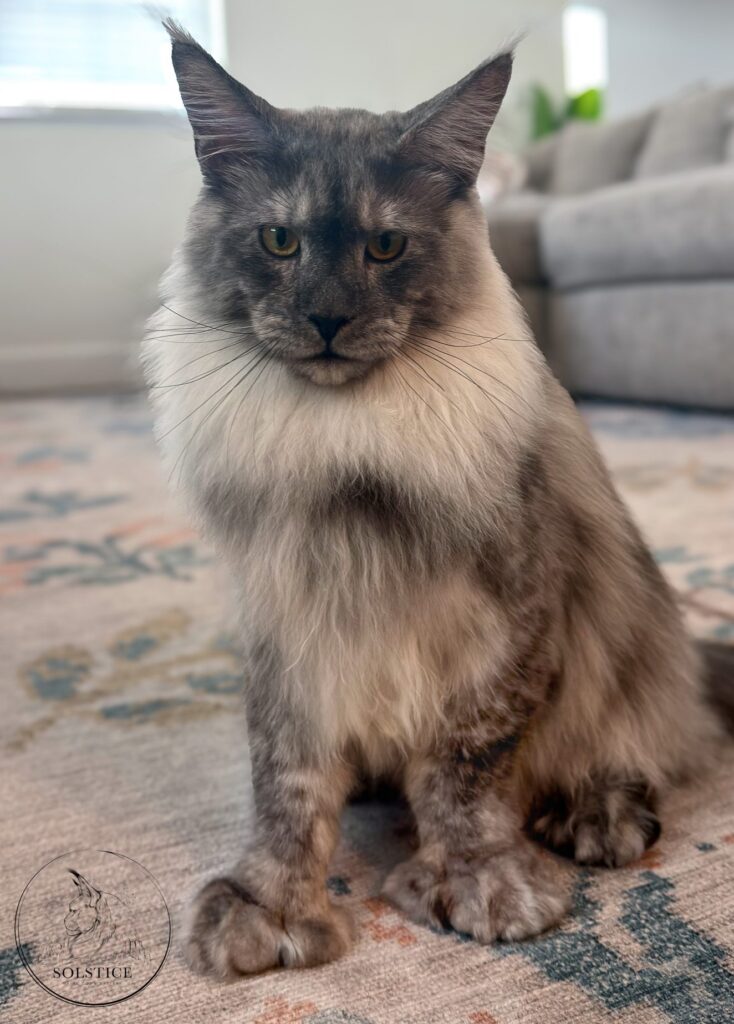
Often called “mitten paws,” this is the most recognizable form of polydactylism. An extra digit develops along the inside of the front paw, creating the appearance of a thumb or mitten. These additional toes are often functional and may help with gripping toys, climbing, and manipulating objects.
Patty Paws
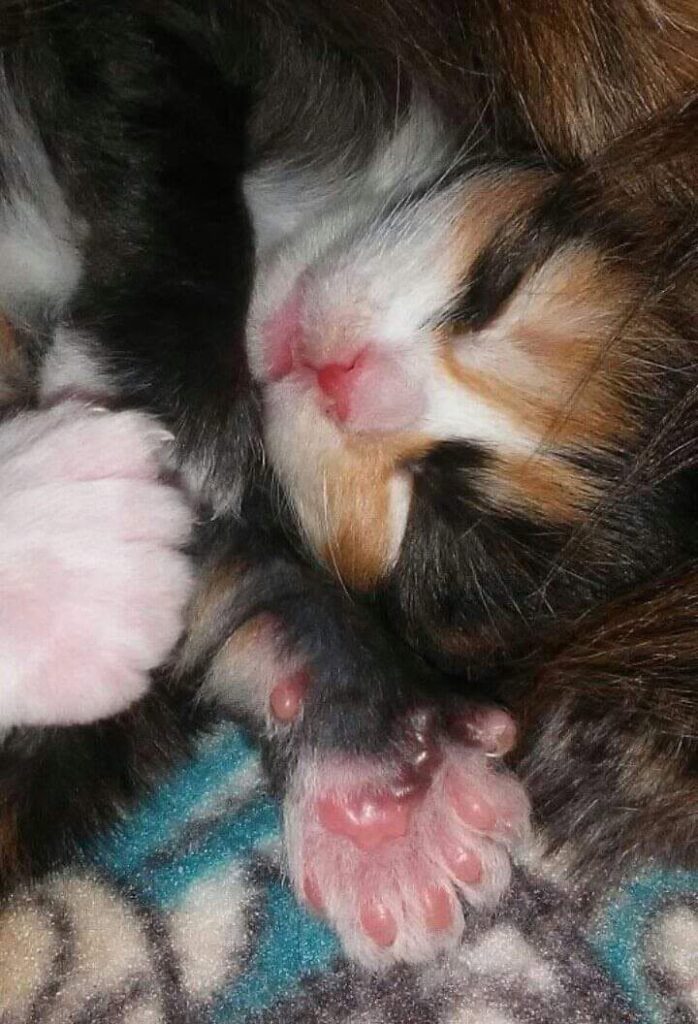
Photo courtesy of Alessandra P. Tassinari, Tassicats. Used with permission.
Instead of the distinct thumb-like appearance seen in mitten paws, some polydactyl Maine Coons develop what enthusiasts commonly call “patty paws.” The extra digits create a wider, more symmetrical paw, increasing the overall surface area. Historically, these broad paws were thought to provide greater stability on snow-covered terrain, contributing to the enduring folklore surrounding polydactyl Maine Coons and their seafaring past.
Rear Paw Polydactyly
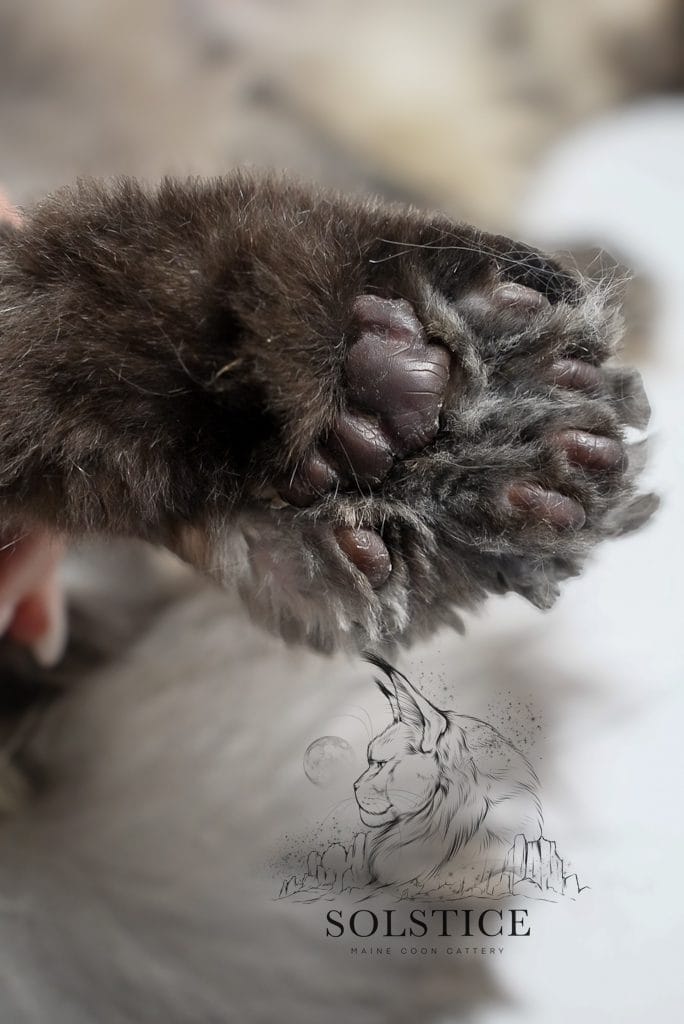
Although extra toes most commonly appear on the front feet, some Maine Coons also have additional digits on their rear paws. Rear paw expression is less common but illustrates the remarkable variation that can occur with this inherited trait.
PAW ANATOMY
A Polydactyl Paw From the Inside
The differences between polydactyl paws extend beyond what we can see externally. These radiographs of our polydactyl Maine Coon sire, Gus, show the skeletal anatomy underlying his additional digits. The number, position, and development of these structures can vary considerably from one polydactyl cat to another.
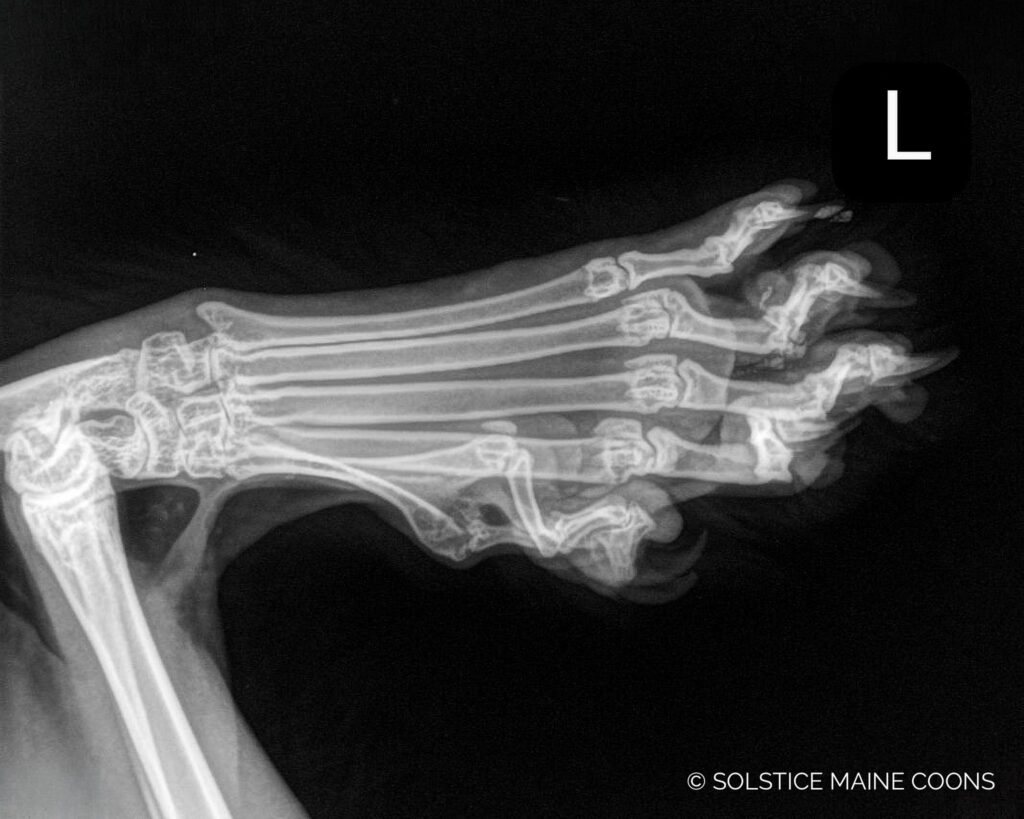
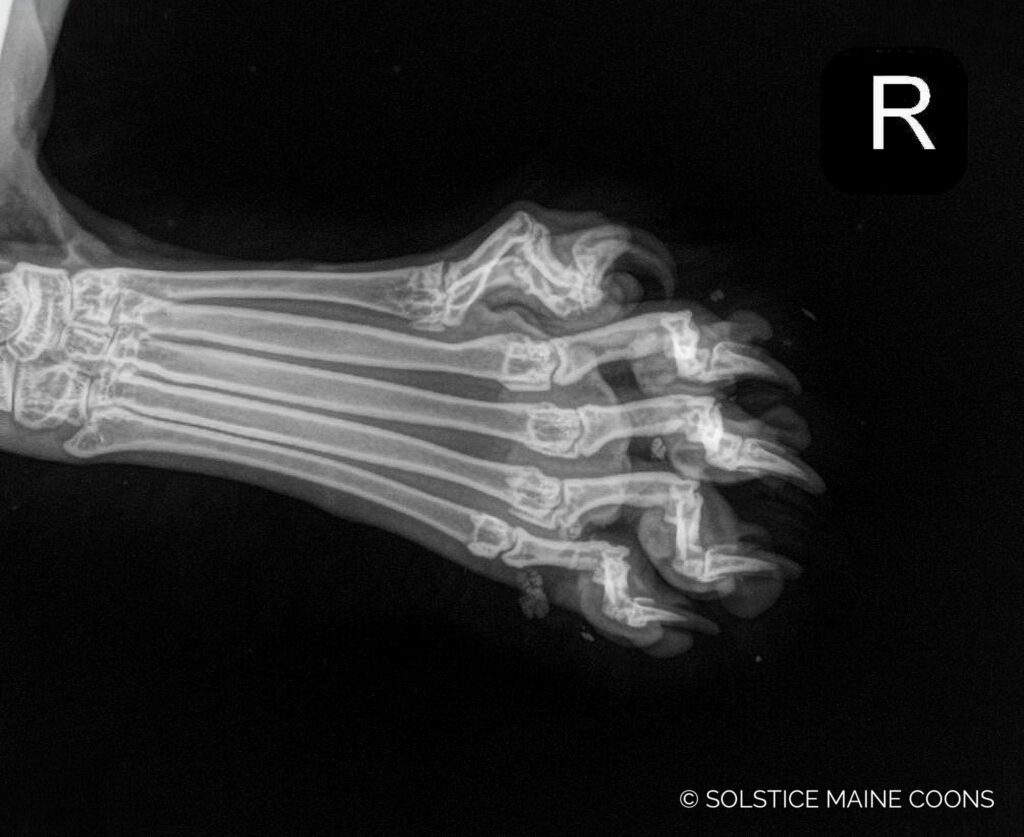
Left and right front paw radiographs of Gus, our 25-toed polydactyl Maine Coon sire.
Did You Know?
Polydactyl Maine Coons can express the trait in remarkably different ways. A clinical study examining 70 Maine Coons, including 48 polydactyl cats, documented considerable variation in digit number, arrangement, and even the underlying structures of the carpus and tarsus. Even closely related cats can develop noticeably different paw structures.
Continue Reading: How Maine Coon Genetics Shape Coat Colors, Patterns, and Traits
The Legendary Paws of Early Maine Coons
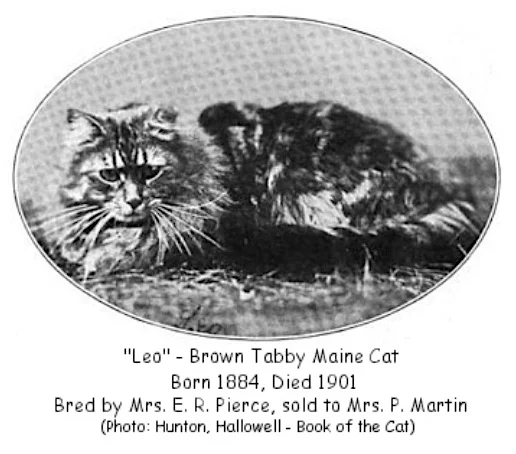
Today’s Maine Coons spend their days curled up on couches, chasing feather toys, and supervising household activities. Their ancestors faced a very different world.
Before the breed became a beloved companion, Maine Coons survived harsh New England winters by hunting rodents, navigating dense forests, and enduring long seasons of deep snowfall. In that rugged environment, every physical advantage mattered. While it’s impossible to know exactly how much extra toes influenced survival, historians and breed experts have long suggested that broader paws offered practical benefits in challenging conditions.
How Common Was Polydactyly in Early Maine Coons?
Polydactyly appears to have been considerably more common in the early Maine Coon population than it became after the breed entered organized cat fancy. Historical breed accounts have frequently estimated that approximately 40% of early Maine Coons were polydactyl.
The origin of that figure is difficult to verify by modern scientific standards. A 1976 interview published in The Scratch Sheet referenced a university-associated study reportedly conducted during the 1950s that found approximately 40% of Maine cats examined were polydactyl. The original study has not been readily located, although the 40% estimate has continued to appear in subsequent Maine Coon breed-history literature.
For that reason, the figure is best understood as a historical estimate rather than a precisely established prevalence rate.
What is clear is that polydactyly has deep roots within the Maine Coon population and was present before the breed’s modern show standards were established.
Built-In Snowshoes
Maine Coons have long been celebrated for their large, tufted paws, one of several physical characteristics traditionally associated with the breed’s ability to withstand New England winters. Historical descriptions have even compared their broad feet to natural “snowshoes.”
Polydactyly can create an even broader paw in some cats. It has long been suggested that this increased surface area may have provided additional stability when navigating snow and uneven terrain. While the idea is plausible and deeply rooted in Maine Coon history, there is currently little scientific evidence demonstrating that extra toes themselves provided a measurable survival advantage.
Better Grip and Balance
Extra digits can create a broader contact area with the ground and other surfaces. While each paw is unique, many owners notice that their polydactyl cats appear especially confident when climbing, balancing, or grasping toys.
Polydactyl cats also became closely associated with maritime folklore. Extra-toed cats were said to have been valued aboard sailing ships as mousers, with their broad paws believed to provide better footing on moving decks.
Historical Note
Polydactyl cats have a long association with maritime folklore. Sailors were said to value extra-toed cats as shipboard mousers and believed their broad paws provided better footing on moving decks.
These stories became intertwined with Maine Coon history, particularly given the breed’s development along the coastal communities of New England. However, historical evidence does not establish that polydactyly itself made Maine Coons better sailors or that shipboard life was responsible for preserving the trait.
What remains is an enduring piece of Maine Coon folklore: broad-pawed working cats, harsh New England winters, coastal ports, and generations of cats whose unusual feet became part of the breed’s identity.
BEYOND THE STANDARD 18
How Many Toes Can A Polydactyl Maine Coon Have?
Most cats are born with 18 toes, five on each front paw and four on each hind paw. Polydactyl Maine Coons may have additional digits on the front paws, hind paws, or all four feet, creating an extraordinary range of individual paw structures.
While 20, 22, 24 and even higher toe counts are seen in polydactyl Maine Coons, the number of toes alone does not tell us how the trait was inherited. As discussed above, polydactyly can vary considerably in its physical expression, even among genetically related cats.
And occasionally, a Maine Coon takes that variation to an extreme.
A 29-TOED MAINE COON
In May 2026, Erebus, a polydactyl Maine Coon from Wisconsin, was officially measured with 29 toes, surpassing the previous Guinness World Records mark of 28 toes that had stood since 2002.
His remarkable paws provide an unusually dramatic example of just how extensively polydactyly can be expressed. Rather than simply adding a uniform extra toe to each foot, his radiographs reveal the complex skeletal anatomy that can exist beneath an exceptionally polydactyl paw.
Guinness World Records recorded the achievement in Kaukauna, Wisconsin on May 13, 2026.
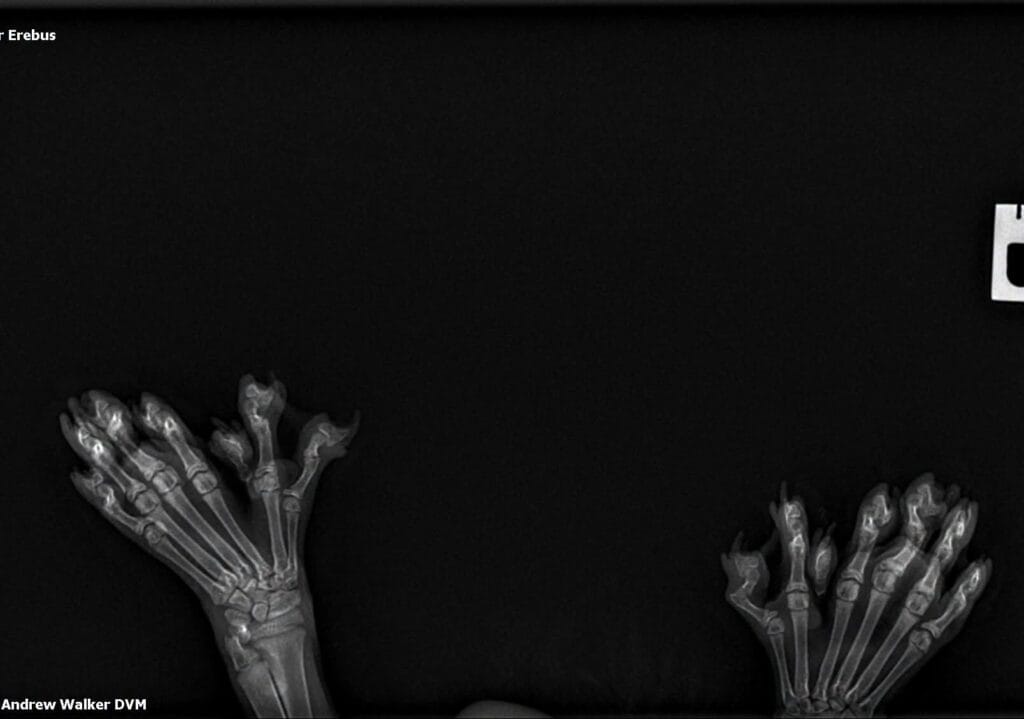
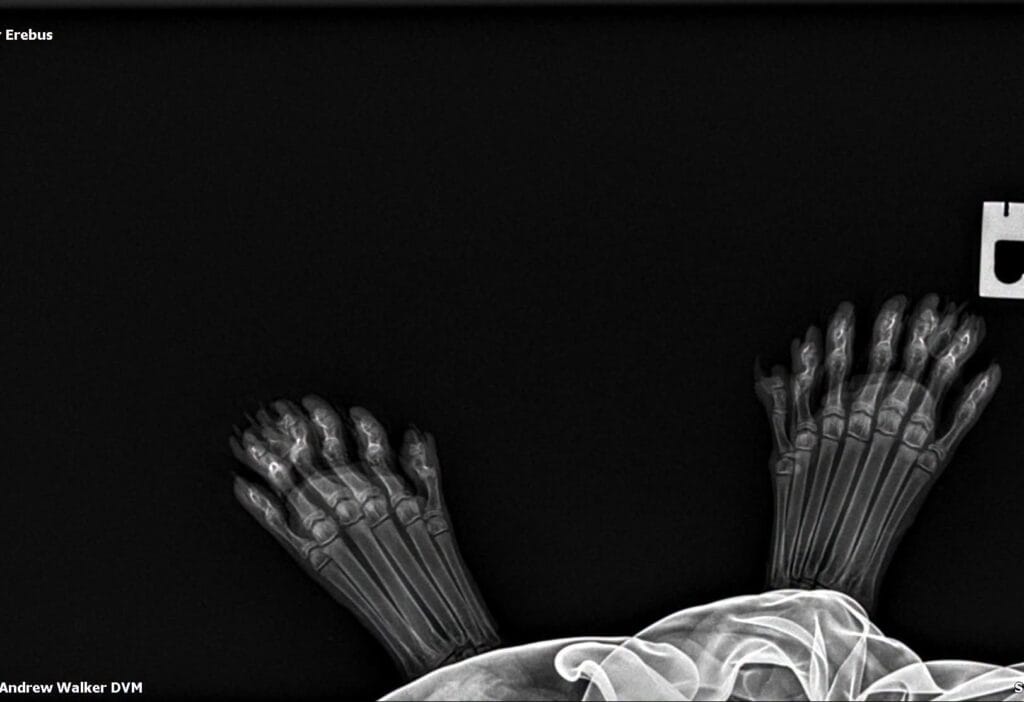
Every extraordinary paw begins with an extraordinary piece of DNA.
The Science
The Genetics Behind Polydactyl Maine Coons
Every polydactyl Maine Coon begins with a small change in DNA. While their oversized paws may appear extraordinary, researchers have identified several of the genetic mechanisms involved in feline polydactyly. Rather than being caused by a problem with the bones or joints, polydactylism results from changes in the genetic instructions that guide how a kitten’s limbs develop before birth.
What Causes Extra Toes?
Polydactyly occurs when genetic changes alter the instructions that guide digit formation during embryonic development. In cats, several known forms of polydactyly have been associated with mutations in the Zone of Polarizing Activity Regulatory Sequence (ZRS), a regulatory region involved in controlling the activity of the Sonic Hedgehog (SHH) gene as the limbs develop.
Despite its playful name, Sonic Hedgehog is an important developmental gene. It helps establish the pattern of a developing limb, including where individual digits form. Changes within regulatory regions controlling SHH activity can alter this developmental pattern and result in the formation of one or more additional digits.
Research specifically involving Maine Coons has shown that the genetics behind their famous paws are more complex than a single mutation. While one known variant has been identified in some polydactyl Maine Coons, other established Maine Coon lines express polydactyly without carrying that variant, suggesting more than one genetic cause exists within the breed.
Not All Polydactyl Cats Share the Same Mutation
Although polydactyl paws may look similar from the outside, the genetics responsible for them are not necessarily identical.
Several variants within the ZRS regulatory region have been identified in domestic cats. These include UK1 and UK2, originally identified in polydactyl cats from the United Kingdom, and the Hw variant, associated with the well-known polydactyl cat population of Key West.
Research involving Maine Coons revealed an even more interesting picture. The Hw variant was identified in some polydactyl Maine Coons, but researchers also studied an established Canadian Maine Coon line in which polydactyly occurred without the Hw, UK1, or UK2 variants.
This means polydactyly within the Maine Coon breed is genetically heterogeneous. In other words, more than one underlying genetic variant can produce the familiar extra-toed phenotype.
Genetics are only part of the story. Polydactyly also demonstrates variable expression, which helps explain why even related cats can develop remarkably different numbers, arrangements, and shapes of extra digits.
How Is the Trait Inherited?
Research in Maine Coons supports polydactyly as an autosomal dominant trait with incomplete penetrance and variable expressivity.
In simple terms, a dominant polydactyl variant can be passed from an affected parent to its kittens without both parents needing to carry the trait. However, Maine Coon polydactyly does not always follow a perfectly predictable textbook pattern.
Incomplete penetrance means that a cat may inherit a genetic variant associated with polydactyly without visibly expressing extra toes.
Variable expressivity means that among cats that do express the trait, the appearance can vary considerably. One cat may develop a single additional digit, while another may have multiple extra digits on several paws. Even closely related cats can have noticeably different paw structures.
For educational purposes, inheritance diagrams often use Pd to represent a dominant polydactyl allele and pd to represent a standard allele. These diagrams are useful for illustrating basic dominant inheritance, but the actual genetics of polydactyly in Maine Coons are more complex because multiple genetic causes appear to exist within the breed.
Possible Inheritance Outcomes
Heterozygous Polydactyl Parent (Pd/pd)
One copy of a dominant polydactyl allele
Pd/pd × pd/pd
Genetic Expectation
• Approximately 50% inherit the dominant allele
• Approximately 50% do not inherit the dominant allele
Physical expression may vary.
Homozygous Polydactyl Parent (Pd/Pd)
Two copies of a dominant polydactyl allele
Pd/Pd × pd/pd
Genetic Expectation
• 100% of kittens inherit one copy of the dominant allele.
• Genetic inheritance does not necessarily predict visible expression.
Physical expression may vary.
A Note About These Examples
These examples illustrate simplified dominant inheritance. Research in Maine Coons has identified variable expressivity, genetic heterogeneity, and incomplete penetrance in some polydactyl lines. As a result, inheritance of a polydactyly-associated allele does not necessarily predict the number, placement, or visible expression of extra digits.
Breeder's Note
Genetics can help us understand how polydactyly is inherited, but they cannot reliably predict exactly how a kitten’s paws will look.
Polydactyly has variable expression, meaning cats carrying a genetic cause of the trait may develop different numbers, placements, and configurations of additional digits. Even littermates can have noticeably different paw structures.
Research has also demonstrated genetic heterogeneity within Maine Coons, meaning more than one genetic variant appears capable of producing polydactyly in the breed. This is one reason these remarkable paws can show so much natural variation.
Breed Standards
Registry Recognition Around the World
USA Registry Comparison
TICA
- Recognized as Maine Coon Polydactyl (MCP)
- Eligible for Championship competition since May 1, 2015
CFA
- Polydactyl Maine Coons may be registered for pedigree tracking
- Designated with polydactyl registration codes 9798/9799
- Polydactyly is not accepted for Championship exhibition
Historical Note
One of the significant milestones in modern polydactyl Maine Coon history came in December 2015, when GCH Mishikoonz Kearsarge Pass, affectionately known as Cat in the Hat, became the first Grand Champion Maine Coon Polydactyl in the United States following TICA’s acceptance of the Maine Coon Polydactyl for Championship competition earlier that year.
PAW HEALTH & CARE
Caring for Those Famous Paws
Polydactylism is a benign inherited trait that does not inherently affect a Maine Coon’s mobility, skeletal structure, or overall health. Those distinctive extra toes, however, do require a little extra attention during routine grooming. Because each paw contains additional digits and skin folds, regular nail trims and simple paw inspections help keep your cat comfortable while preventing minor issues from becoming more serious.
With just a few minutes of routine maintenance every few weeks, your polydactyl Maine Coon’s remarkable paws can remain healthy throughout their lifetime.
Hidden Claws Need Special Attention
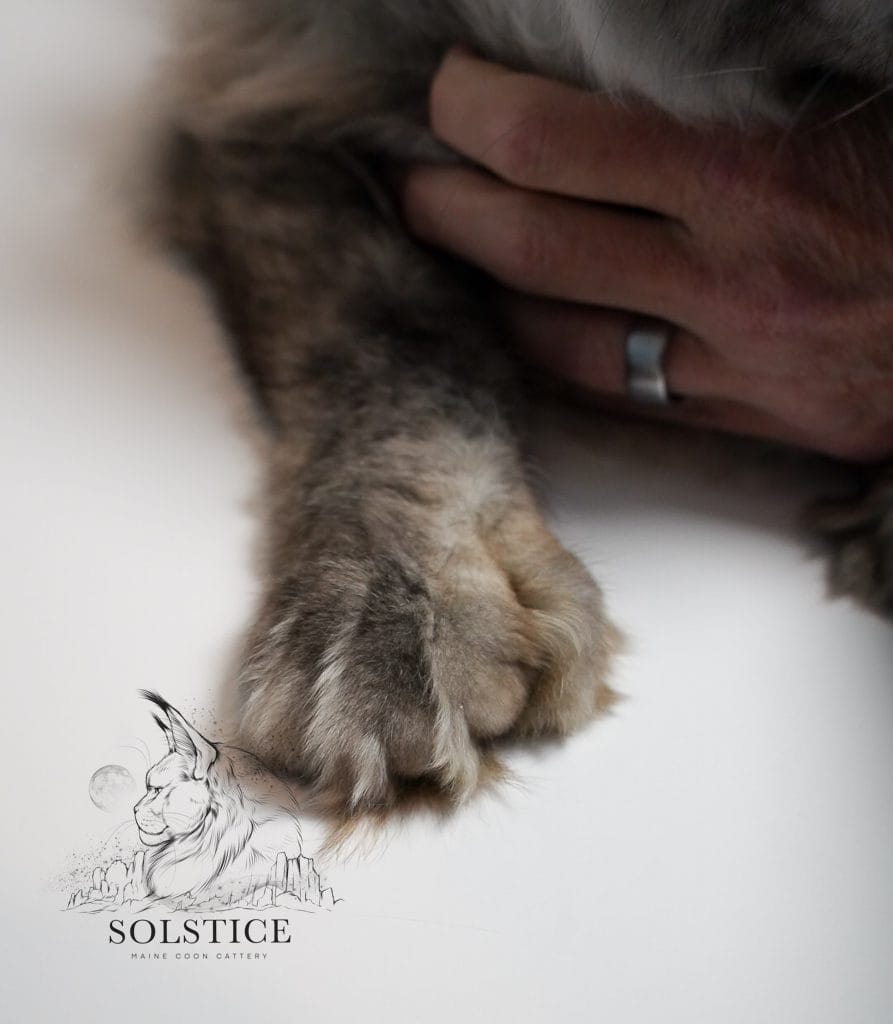
One of the most important aspects of caring for a polydactyl Maine Coon is monitoring the extra claws found on mitten-style paws.
Unlike the primary claws that naturally wear down through scratching and daily activity, these “thumb” claws often sit higher on the paw and may never make contact with the ground. As a result, they receive very little natural wear and continue to grow unless they are trimmed.
If left unchecked, an overgrown claw can curl back toward the paw pad and eventually grow into the surrounding tissue, causing discomfort, lameness, and infection.
Make it a habit to gently inspect each extra toe every few weeks and trim the nails as needed. Incorporating paw checks into your regular grooming routine is the easiest way to prevent problems before they develop.
Inspect Between the Toes
The additional skin folds created by extra digits can occasionally collect litter dust, loose fur, dirt, or moisture.
During routine grooming, gently spread each toe and inspect the spaces between the digits. If you notice debris, simply wipe the area with a soft, damp cloth or a pet-safe grooming wipe, then dry the paw thoroughly before your cat resumes normal activity.
Regular inspections take only a few moments and help maintain healthy skin while reducing the risk of irritation.
Choose Sturdy Scratching Surfaces
Maine Coons are large, powerful cats, and their scratching posts should be just as substantial.
Choose tall, stable scratching posts wrapped in tightly woven sisal rope or offer oversized cardboard scratchers that allow for a full-body stretch. These surfaces encourage healthy scratching behavior and help maintain normal nail wear.
If your cat has mitten-style paws, avoid scratching surfaces made from loose-loop carpet. Extra claws can occasionally become snagged in the fibers, increasing the risk of a torn nail or injured digit.
Veterinary Insight
Polydactylism is not the same as radial hypoplasia.
Because both conditions affect a cat’s paws, they are sometimes confused. However, they are entirely different genetic conditions.
Polydactylism simply results in additional digits on otherwise healthy paws. It does not weaken the bones, alter normal joint development, or inherently limit mobility.
Radial hypoplasia, sometimes referred to as “twisty cat syndrome,” is a separate congenital condition that affects the development of the forelimbs and can significantly impact a cat’s movement and quality of life.
A healthy polydactyl Maine Coon can run, jump, climb, and play just like any other Maine Coon.
Start Paw Care Early
One of the best ways to make lifelong grooming easier is to begin handling your kitten’s paws from an early age.
At Solstice, paw handling is incorporated into our regular socialization routine from kittenhood. By gently touching each toe, extending the claws, and pairing the experience with calm reassurance, kittens learn that nail trims and paw inspections are simply part of everyday life.
This early, positive handling helps create confident adult cats that are far more comfortable with routine grooming, both at home and during veterinary visits.
Interested in a Polydactyl Maine Coon?
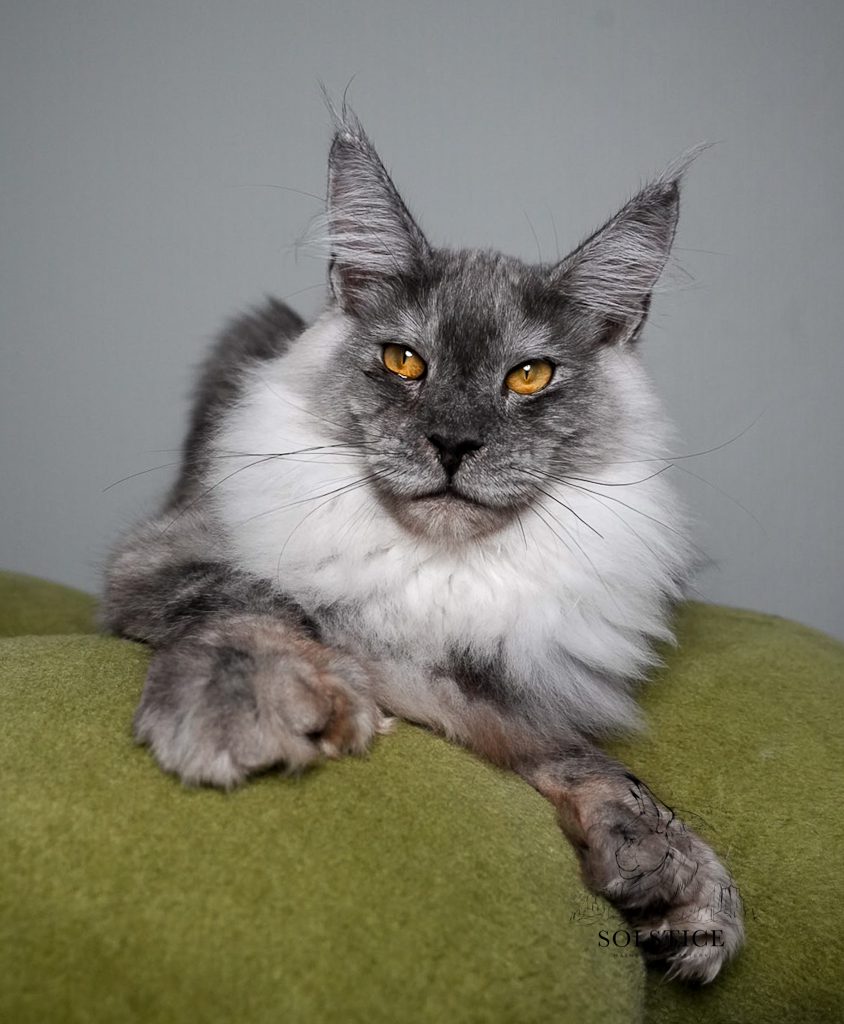
At Solstice Maine Coons, polydactyly is one of the many naturally occurring traits we thoughtfully preserve within our breeding program. Our breeding cats are selected with health, temperament, structure, genetic diversity, and the preservation of the Maine Coon breed at the forefront.
Our polydactyl sire Gus represents this remarkable piece of Maine Coon history, and select upcoming litters may include polydactyl kittens.
Sources and further reading
The information presented on this page is supported by published veterinary research, breed registry standards, and historical documentation of the Maine Coon breed.
Hamelin, A., Begon, D., Conchou, F., Fusellier, M., & Abitbol, M. (2017).
Clinical characterisation of polydactyly in Maine Coon cats. Journal of Feline Medicine and Surgery, 19(4), 382–393.
Hamelin, A., Conchou, F., Fusellier, M., Duchenij, B., Vieira, I., Filhol, E., Dufaure de Citres, C., Tiret, L., Gache, V., & Abitbol, M. (2020).
Genetic heterogeneity of polydactyly in Maine Coon cats. Journal of Feline Medicine and Surgery, 22(12), 1103–1113.
Curtis, S. L., & King, L. (2007).
Observations of Feline Polydactyly. PawPeds.
Shaw, D. (1976).
The Origin of the Maine Coon, Part III. Interview by Mike Hicks, Beth Hicks & Rick Bramham. Archived by PawPeds.
Simpson, Frances. (1903).
The Maine Cats. In The Book of the Cat. Cassell & Company.
The International Cat Association (TICA).
Maine Coon Polydactyl.
The International Cat Association (TICA).
Maine Coon Polydactyl Breed Standard.
The International Cat Association (TICA). (2015).
Winter 2015 Board Meeting Minutes. Championship advancement of the Maine Coon Polydactyl effective May 1, 2015.
Cat Fanciers’ Association (CFA).
Maine Coon Cat Registration Rules. Includes registration provisions and breed codes for polydactyl Maine Coons.
Guinness World Records. (2026).
Most toes on a cat. Record held by Erebus, a Maine Coon with 29 toes, verified May 13, 2026.
Lockwood, A., Montgomery, R., & McEwen, V. (2009).
Bilateral radial hemimelia, polydactyly and cardiomegaly in two cats. Veterinary and Comparative Orthopaedics and Traumatology, 22(6), 511–513.
Maine Coon Polydactyl. (2015).
First US Grand Champion MCP in TICA. Historical documentation of GCH Mishikoonz Kearsarge Pass becoming the first Grand Champion Maine Coon Polydactyl in the United States.
A note about historical sources: Some accounts regarding the prevalence and possible functional advantages of polydactyly in early Maine Coons are based on historical observations, interviews, and breeder accounts rather than controlled scientific studies. Where possible, Solstice Maine Coons distinguishes these historical theories from findings supported by modern genetic and veterinary research.