If you’ve searched for a Ragdoll Maine Coon mix, you may have come across the term “Ragcoon.” While the name is commonly used online, a Ragcoon is not a recognized cat breed. It simply describes a cat with both Ragdoll and Maine Coon ancestry.
Both parent breeds are known for their large size, beautiful coats, and affectionate personalities, but crossing them does not create a predictable combination of the two breeds.
In this guide, we’ll look at what a Ragdoll Maine Coon mix actually is, how Maine Coons and Ragdolls differ, what genetics can and cannot predict, and why our own experience with one Ragdoll × Maine Coon litter ultimately strengthened our commitment to breeding pedigreed Maine Coons.
Editor’s Note: An Update From Solstice Maine Coons
This article was originally written early in my breeding journey, when I explored the idea of crossing a Ragdoll with a Maine Coon and ultimately produced one litter from that pairing. At the time, I was genuinely intrigued by the characteristics of both breeds and excited to see what the pairing would produce.
As my experience with Maine Coons grew, so did my understanding of breed preservation, responsible breeding practices, and the importance of maintaining the characteristics that make each established breed distinct. That experience helped clarify the direction I wanted for my program.
Solstice Maine Coons no longer breeds Ragdoll × Maine Coon crosses. We produced one such litter and chose not to continue. Today, our breeding program is devoted exclusively to pedigreed Maine Coons, with thoughtful selection, comprehensive health testing, temperament, structure, and responsible preservation of the breed at the center of our program.
I’ve chosen to keep and update this article because people continue to search for terms such as “Ragcoon,” “Ragdoll Maine Coon mix,” and “Maine Coon Ragdoll mix.” Rather than erase an earlier chapter of our program, I believe there is more value in being transparent about it while providing accurate information for families researching these cats today.
Our breeding philosophy has evolved with experience and education, and I believe being willing to learn, reevaluate, and grow is an important part of responsible breeding.
What Is a Ragdoll Maine Coon Mix?
A Ragdoll Maine Coon mix is a cat with ancestry from both the Ragdoll and Maine Coon breeds. You may also see these cats referred to online as “Ragcoons,” although this is an informal nickname rather than the name of a recognized breed
Both Maine Coons and Ragdolls are established breeds with their own histories, breed standards, physical characteristics, and temperament tendencies. Crossing the two does not create a new breed or a predictable combination of exactly half Maine Coon and half Ragdoll characteristics.
Instead, each kitten inherits a unique combination of genes from its parents. This means kittens from the same litter can differ considerably in appearance, structure, coat, size, and personality.
Is a Ragdoll Maine Coon Mix Still a Maine Coon?
No. A kitten produced from a Maine Coon and a Ragdoll is a mixed-breed cat with ancestry from both breeds. It is not a pedigreed Maine Coon or a pedigreed Ragdoll. This distinction is important when researching kittens online. Terms such as “Ragcoon,” “Maine Coon mix,” or “Ragdoll Maine Coon” can describe ancestry, but they should not be used to imply that the resulting cat is a recognized breed. A pedigreed Maine Coon comes from documented Maine Coon ancestry and is bred according to an established breed standard. The same is true of a pedigreed Ragdoll.
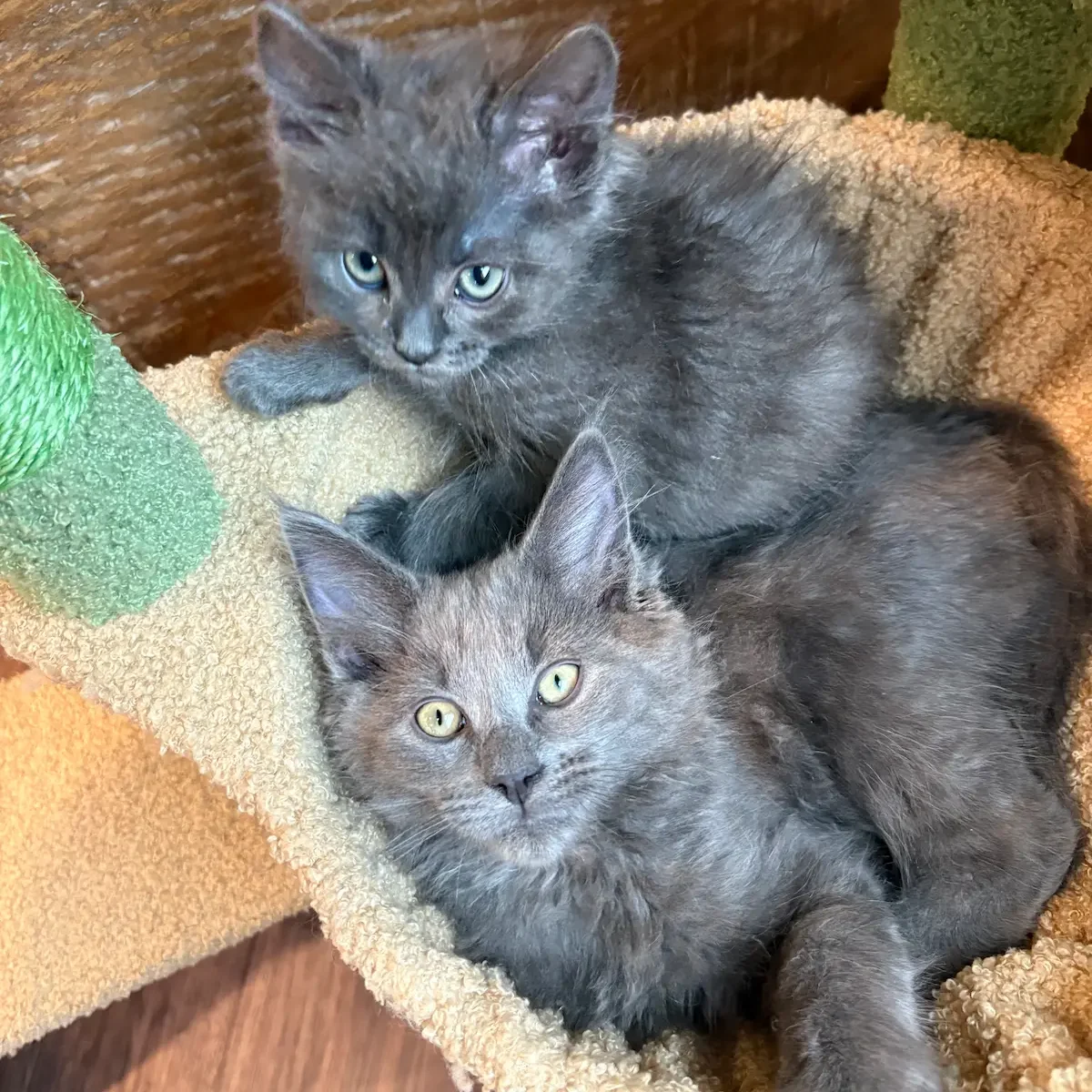
Is a “Ragcoon” a recognized breed?
No. “Ragcoon” is an informal term for a Ragdoll × Maine Coon mix. These cats can certainly be wonderful companions, but they do not constitute a recognized breed with an established breed standard.
Maine Coon vs. Ragdoll: What’s the Difference?
It’s easy to understand why Maine Coons and Ragdolls are sometimes compared. Both are large, longhaired breeds known for being affectionate companions, and both can take several years to reach full physical maturity.
Beyond those similarities, however, they are distinctly different breeds.
Maine Coons developed as rugged working cats in New England and are known for their substantial, rectangular bodies, shaggy coats, square muzzles, large ears, and social, playful personalities.
Ragdolls are a considerably newer breed, developed in California during the 1960s. Traditional Ragdolls are known for their substantial build, soft semi-long coat, blue eyes, and pointed coloration. Mink and other nontraditional lines are now classified separately as Cherubim within TICA, whose standard allows additional coat and eye colors, including aqua eyes. Both are known for their typically gentle, affectionate temperaments.
Neither breed is simply a different version of the other. Each has its own history, physical characteristics, breed standard, and genetic population. Those differences become especially apparent when you compare mature examples of the two breeds side by side.
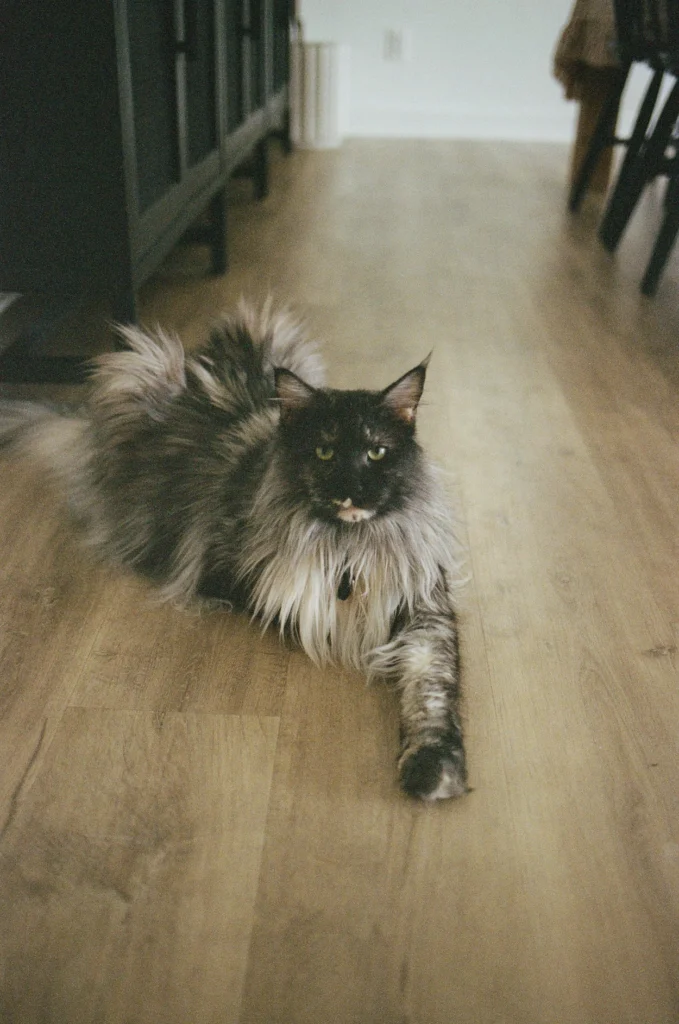
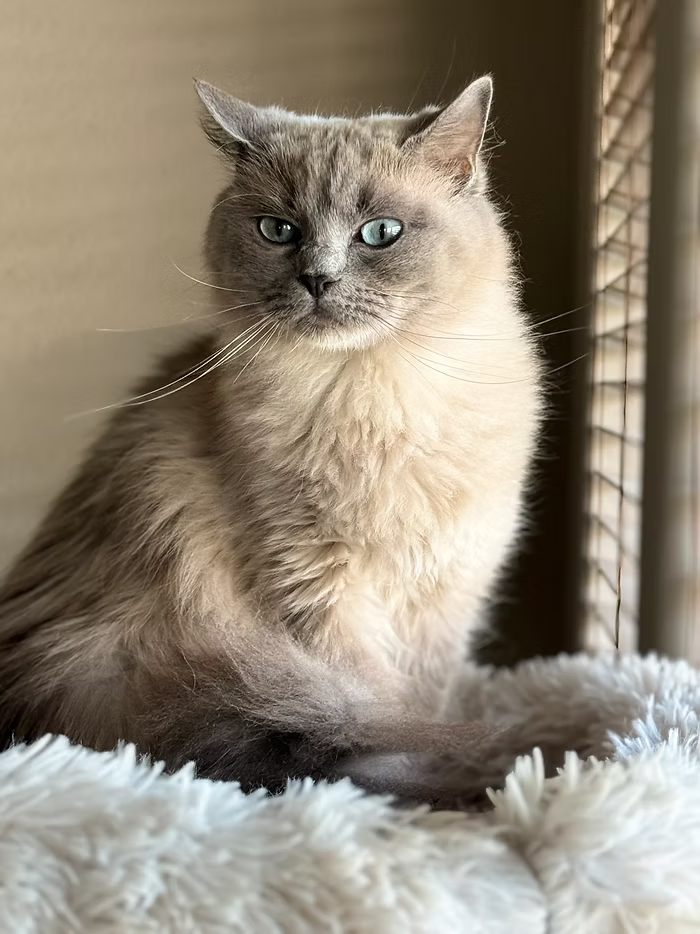
Maine Coon vs. Ragdoll at a Glance
Although both breeds are large, affectionate cats, their physical characteristics and breed standards are quite different.
| Characteristic | Maine Coon | Ragdoll |
|---|---|---|
| Origin | New England, United States | California, United States |
| Overall build | Long, substantial, rectangular and muscular | Large, substantial and broad |
| Head & muzzle | Medium-width head with a square muzzle | Broad, modified wedge with gently rounded contours |
| Ears | Large, tall and wide at the base | Medium-sized with a slight forward tilt |
| Coat | Shaggy, uneven coat with a light undercoat | Soft, silky semi-long coat with minimal undercoat |
| Tail | Long, wide at the base and heavily furnished | Long and well-furnished |
| Eyes | Large eyes in several accepted colors | Blue in traditional Ragdolls; additional eye colors, including aqua, are recognized in Cherubim |
| Colors & patterns | Wide variety of accepted colors and patterns | Traditional pointed colors and patterns; Cherubim includes additional nontraditional colors and patterns |
| Temperament | Social, curious, playful and interactive | Gentle, affectionate and typically easygoing |
| Maturity | Slow maturing, often several years | Slow maturing, often several years |
Physical appearance isn’t the only difference between these breeds. Maine Coons are generally known for being social, curious, playful, and highly interactive, while Ragdolls are typically described as gentle, affectionate, and easygoing. Both are large, slow-maturing breeds, although their body structure differs considerably. As with appearance, crossing the two does not guarantee that a kitten will inherit a particular temperament, adult size, or an ideal combination of traits from both breeds.
What Can a Ragdoll Maine Coon Mix Look Like?
One of the biggest misconceptions about mixed-breed cats is that kittens will inherit an even blend of the most recognizable traits from each parent. Genetics do not work quite that neatly.
A Ragdoll Maine Coon mix may inherit characteristics from either parent in many different combinations. Even kittens from the same litter can vary noticeably in coat texture, color, pattern, facial structure, body type, eye color, size, and overall appearance.
For example, a kitten does not automatically inherit the Maine Coon’s square muzzle, large ears, shaggy coat, and substantial rectangular frame simply because one parent is a Maine Coon. Likewise, having a Ragdoll parent does not guarantee the soft coat, blue eyes, pointed pattern, or characteristic appearance associated with a traditional Ragdoll.
This is one reason it is important to distinguish ancestry from breed. A mixed kitten may resemble one parent strongly, show characteristics of both, or eventually look quite different from what someone expected when the kitten was young.
What About Mink Ragdolls and Aqua Eyes?
Under TICA’s current standards, the Ragdoll remains a blue-eyed, pointed breed. Cats from Ragdoll lines with mink, sepia, solid, and other nontraditional coloration are now classified as Cherubim, a breed within the Ragdoll Breed Group that shares the Ragdoll’s body and head type but allows a broader range of colors.
This is relevant to our own litter because Avie, now known as Muffins, was a blue mink female. At the time we bred her, we referred to her as a mink Ragdoll, which was the terminology commonly being used for her lineage and coloration. Under TICA’s current classification, that coloration falls within the Cherubim standard rather than the traditional Ragdoll standard.
Can a Ragdoll Maine Coon Mix Have Blue Eyes?
Yes, a Ragdoll Maine Coon mix can have blue eyes, but blue eyes are not guaranteed simply because one parent is a Ragdoll.
Traditional Ragdolls are a pointed breed, and blue eyes are part of the Ragdoll breed standard. TICA’s current standard requires Ragdolls to have blue eyes.
Eye color in a mixed litter depends on the genetics inherited from both parents. The genes responsible for pointed coloration and associated blue eyes are recessive, meaning a kitten generally needs to inherit the appropriate colorpoint allele from both parents to express the pointed pattern. A Maine Coon that does not carry colorpoint would therefore not be expected to produce pointed, blue-eyed kittens when bred to a pointed Ragdoll.
This becomes a little more complex when mink coloration is involved. Under TICA’s current Ragdoll Breed Group standard, mink cats are classified as Cherubim rather than Ragdolls. Mink Cherubim have aqua eyes, ranging from blue-green to green-blue, rather than the blue eyes required in a traditional Ragdoll.
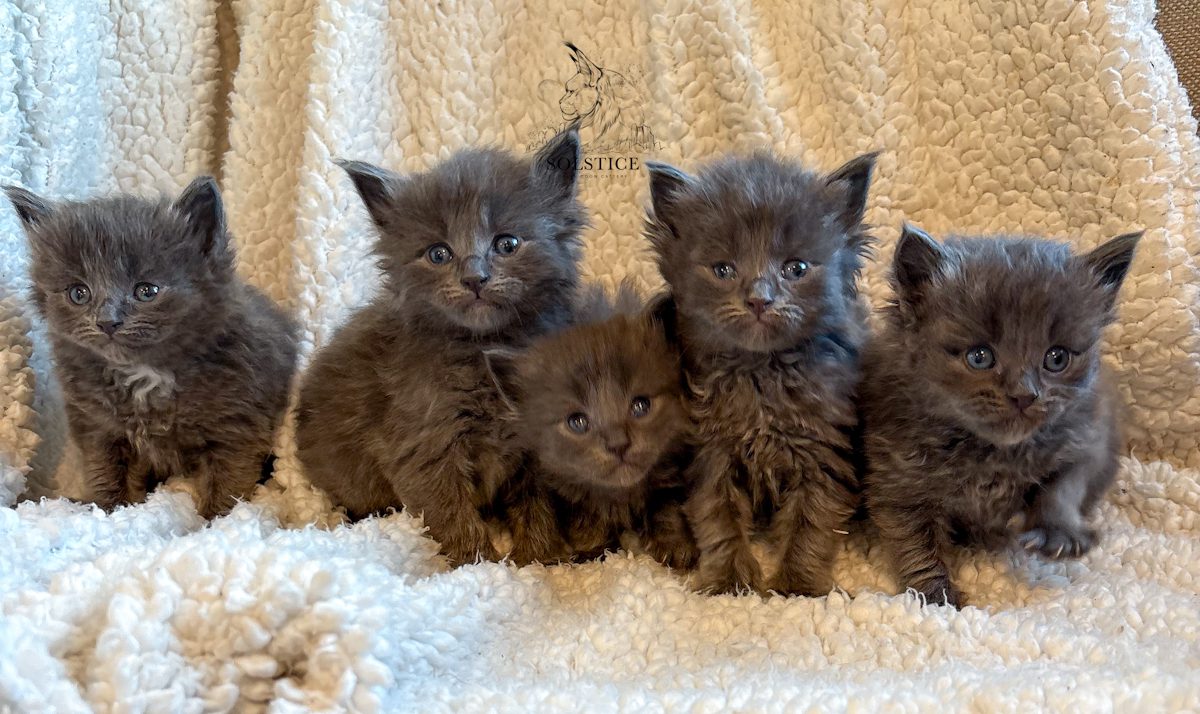
Our own mixed litter was produced from a blue mink female, Avie, and our Maine Coon sire, Thor. Their kittens inherited different combinations of the genetics carried by each parent, which could be seen not only in their eye color, but increasingly in their overall appearance as they grew.
For that reason, our kittens should not be viewed as examples of what every Ragdoll Maine Coon mix will look like. There is no single appearance, size, coat, eye color, or temperament that can be expected from this type of cross.
What Did Our Ragdoll Maine Coon Mix Kittens Grow Up to Look Like?
Because we produced one Ragdoll × Maine Coon litter ourselves, we have had the opportunity to see how several of those kittens developed beyond kittenhood. Their growth provides a useful real-world example of just how much variation can occur even among kittens with the same two parents.
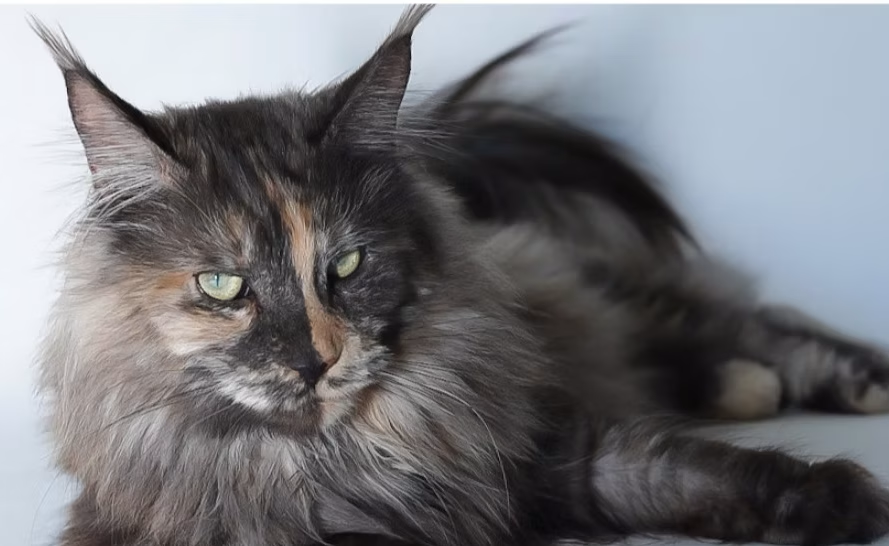
Kiara, Spec, and Big are littermates from our Avie × Thor pairing. In the photographs below, Kiara is 15 months old, while Spec and Big are 10 months old. Even at these relatively young ages, differences can be seen in their coat length and texture, facial features, ears, body type, and overall appearance.
These differences are exactly why there is no single “Ragdoll Maine Coon mix” look. Each kitten inherits its own combination of genes from its parents, and siblings from the same litter can develop quite differently.
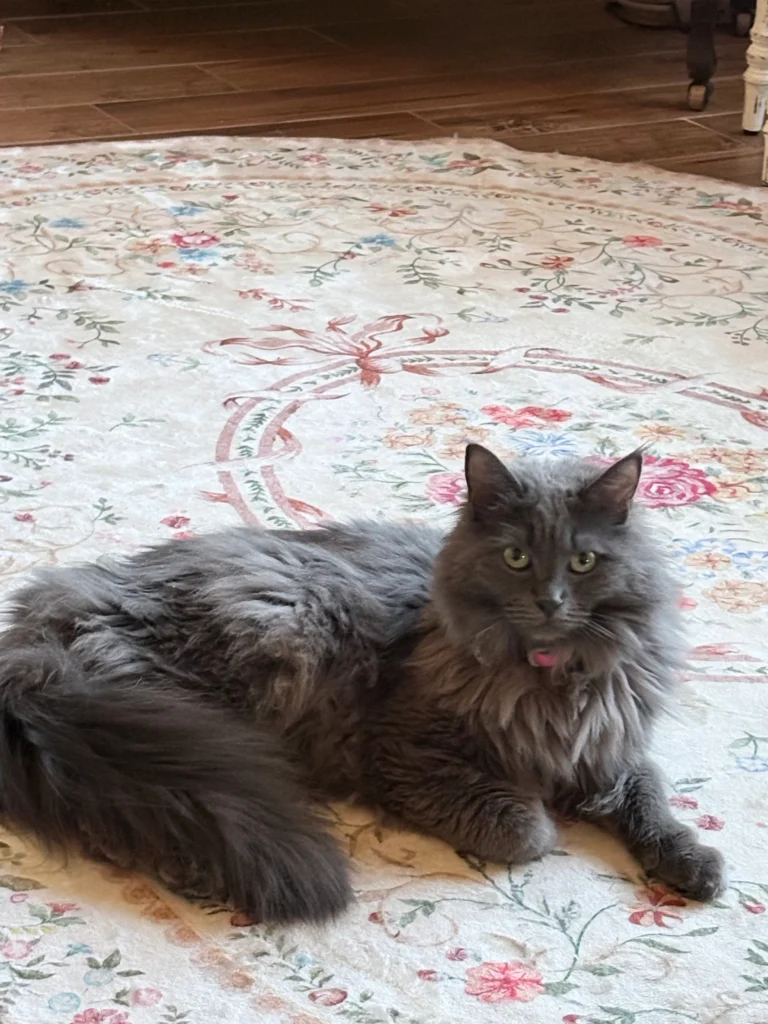
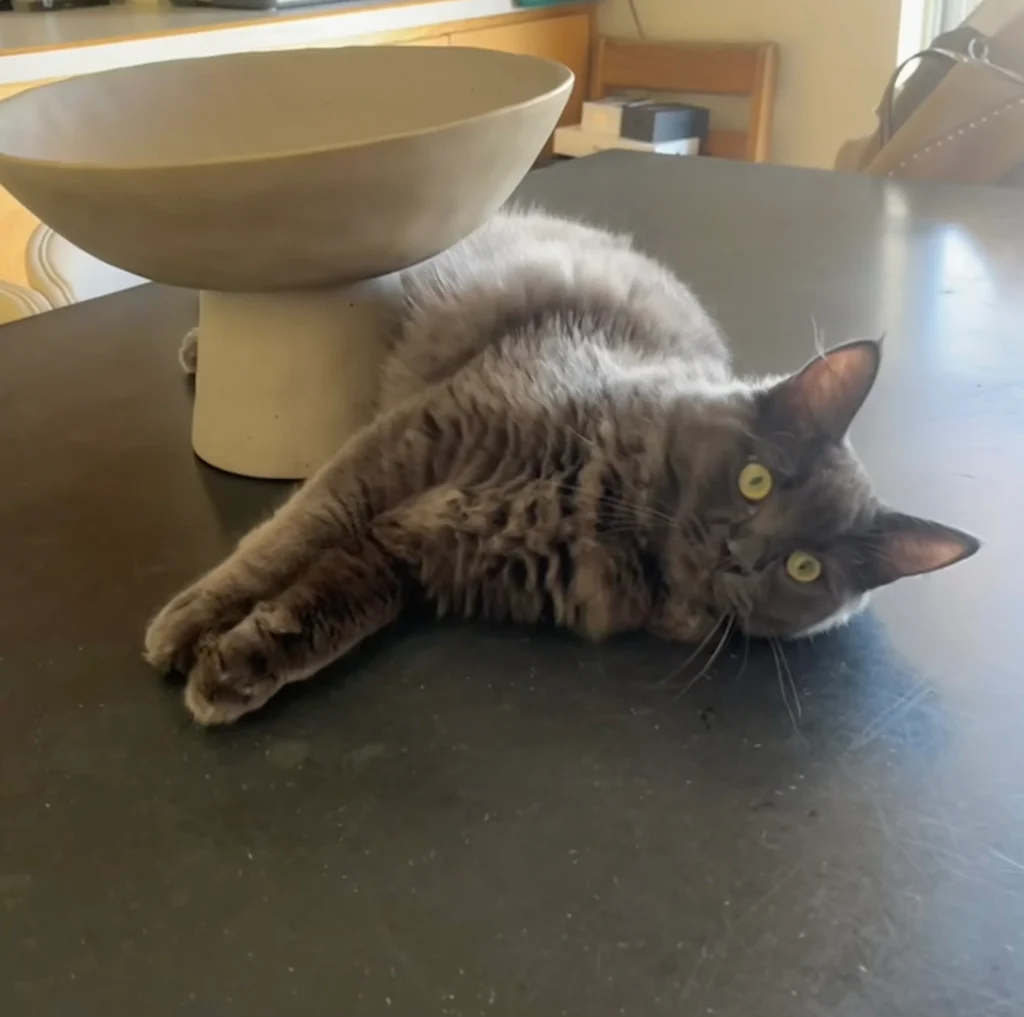
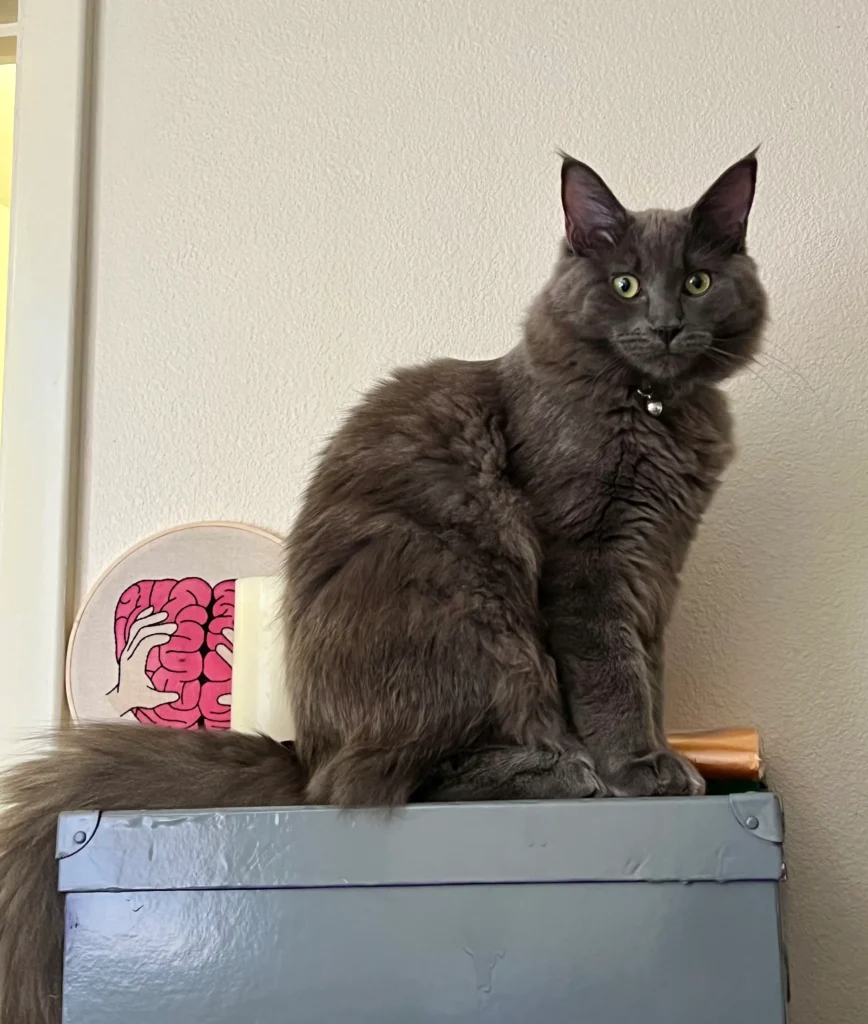
It is also important to remember that these photographs do not show fully mature cats. Both Maine Coons and Ragdolls are slow-maturing breeds, and cats with ancestry from the two can continue developing well beyond their first year. These images are snapshots of Kiara, Spec, and Big as young cats rather than representations of their final adult size or appearance.
More importantly, none of them needs to look “more Maine Coon” or “more Ragdoll” to be a successful example of the cross. They are mixed-breed cats with ancestry from both breeds. Individual physical traits do not make them pedigreed representatives of either one.
Why We Chose to Focus Exclusively on Maine Coons
Producing this litter was part of my early experience as a breeder, and seeing the kittens develop gave me an even greater appreciation for the role that thoughtful selection, documented ancestry, and established breed standards play in responsible breeding.
I came to realize that what fascinated me most was not creating a combination of two breeds I loved. It was learning the Maine Coon in greater depth and working toward the qualities that have defined the breed for generations.
That realization shaped the direction of Solstice Maine Coons. We produced one Ragdoll × Maine Coon litter and chose not to repeat the cross. Our program today is devoted exclusively to pedigreed Maine Coons, with comprehensive health testing, temperament, structure, genetic diversity, and preservation of the breed guiding our breeding decisions.
I have chosen to keep this article because our experience is part of our history, and because families continue to search for information about Ragdoll Maine Coon mixes. I would rather use that experience to provide honest context than erase an earlier chapter of our program.
Breeding programs can evolve as breeders gain experience, continue their education, and refine their goals. Ours did. That evolution ultimately gave us a much clearer understanding of what we wanted Solstice Maine Coons to become.
References & Further Reading
The International Cat Association (TICA). “Maine Coon Breed Standard.”
TICA Breed Standards: Main Coon
Used for Maine Coon structure, head and muzzle, ears, coat, body type, accepted characteristics, and breed standard information.
The International Cat Association (TICA). “Ragdoll Breed Introduction and Breed Standard.”
TICA Ragdoll Breed Introduction
Used for Ragdoll history, temperament, physical characteristics, blue eyes, size, and slow maturation. TICA identifies Ann Baker as developing the breed in California in the early 1960s and describes Ragdolls as large, semi-longhaired cats with blue eyes.
The International Cat Association (TICA). “Cherubim.”
TICA Cherubim Breed Information
Used for the current Cherubim classification, its relationship to the Ragdoll Breed Group, accepted mink, sepia and solid colors, temperament, size, and maturation.
The International Cat Association (TICA). “Ragdoll Breed Group Rational.”
TICA Ragdoll Breed Group and Cherubim Standard Changes
Useful specifically for explaining why mink, sepia, and solid cats were separated into the Cherubim breed within the Ragdoll Breed Group rather than continuing to be classified as Ragdolls.
Cat Fanciers’ Association (CFA). “Ragdoll Breed Standard.”
CFA Ragdoll Breed Standard
Additional breed-standard reference for traditional Ragdoll coloration, pointed patterns, and blue eye color.